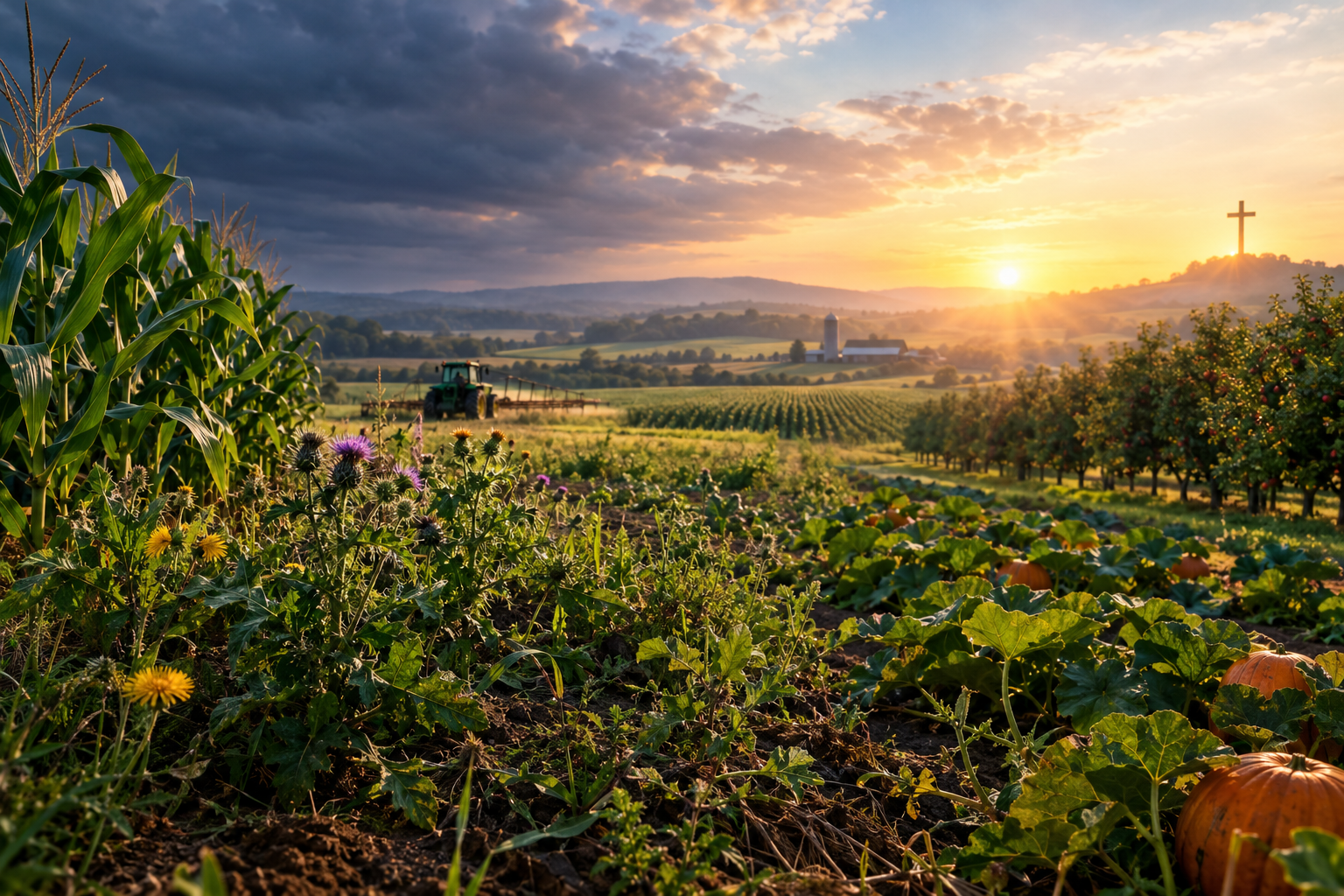
Thorns and Thistles: A Christian View of Farming after the Fall – by Andrew Mcguire
Weeds.
A patch in the far cornfield that’s escaped. Are they resistant to the herbicide or just a skip in spraying?
Too many in the pumpkin patch. Was the timing of the roller-crimper off, or was it that rain right afterwards?
A mess in that Cosmic Crisp block. Was that where the sprayer got stuck in the mud last fall after the drip system leaked between the tree rows?
Thorns and thistles.
Weeds…because we did something wrong, didn’t mimic nature, or have degraded soil. Or thorns and thistles…because that is what we expect from a good, but cursed creation.
Both views see the same reality, but interpret it differently. Your view of this reality will affect your expectations, reasoning, and farming decisions. It will impact how you respond to challenges, setbacks, and even weeds. It won’t make farming any easier, but it will allow you to avoid pitfalls and unfruitful ideas. It can help you navigate the complexity of farming and bypass any guilt stemming from not farming the “right” way.
I doubt there is one Christian way of farming, but there is one Christian way of viewing farming, a view based on God’s revelation in the Bible. One that recognizes God’s creation and the effects of the Fall, what we can achieve and what we can’t, and our ultimate hope for the future of God’s creation. How we view farming is the topic of this book.
Creation and the Fall
This Christian view of farming starts with creation and the Fall.
God created the heavens and the earth, filled them with life, and it was good. He had created people in his own image, gave them dominion over all the other living things, gave them food, and told them to fill the earth, and it was very good.
God planted a garden in Eden with trees for food, except for one which was off-limits. God told Adam and Eve to work and keep the garden; work was good. They lived in the garden with God, but the serpent was also there.
The man and woman believed the serpent’s lies and ate from the tree of which God had told them not to eat. As God had warned, death came, along with other consequences for them and for the rest of creation.
The good and very good creation was subjected to degrees of decay, decline, disease. Filling the earth became painful, first in childbirth, then in feeding all those who were born. The ground—all of creation—was cursed. Farming was explicitly part of this. Work was cursed; getting food from the cursed ground became painful and difficult, requiring effort against the weeds, insects, and diseases. Finally, we, in the first Adam, were sent out of the garden and the way back blocked.
All this we call the Fall, and we have been dealing with its consequences since.
Good Corrupted
Although creation was corrupted, it was not ruined. By observing carefully, at specific instances or places of beauty, we can see that the Fall and its consequences did not remove creation’s goodness.
Creation was subjected to corruption, and so it is no longer only good—it is good thwarted, opposed, marred, diminished, tarnished, diseased, and decaying by corruption. But it’s not a mixture of white and black that then looks gray; it’s wheat and weeds, for now growing together distinctly wheat and weeds, but to be separated in the end.
The world is good; it is also a mess. We are good, and we are a mess. We can still see that good, the beautiful, often if we look for it, but always accompanied by corruption, and a groaning, waiting for restoration.
Longing for Eden
Because all of us can still see the good of creation, but also the ever-present corruption, we must deal with the presence of both. The most common response is discontent. We look around and see that creation is not as it should be, as it was designed to be, as it was before. We long for what was lost in the Fall and for its restoration.
This longing for Eden, for God’s good and very good creation unmarred by the Fall, and for God’s very presence, is shared by all humanity. Some may not acknowledge this desire, but it is revealed in our attempts to set things right, to fix what we see as broken, in creation and in farming.
This is the expected and rational response to our shared discontent. Though we long to return to Eden, we cannot. God tells us the way is blocked. There is no way back, but there is a way forward.
God’s Plan for Restoration
So our feelings are justified; trying to fix it ourselves is where we go wrong. We cannot restore creation or farming; only God can. God has a plan for restoring both us fallen people and cursed creation.
Although the plan connects the two, they are now separate. God’s plan for restoring us fallen people is salvation through Jesus Christ. This restoration from the effects of the Fall for us is both now and partial, and in the end, in full. For creation, there is presently not yet any lifting of the Fall’s curse, but God will do it eventually.
The problem is the timing and the actor; we want restoration now, by us. God’s plan is in the end, by him.
Mitigating the Effects of the Fall
The good news is that while we wait for God’s plan to be carried to completion, we can mitigate the effects of a cursed creation. We do not remove the curse, but we can lessen the effects, or make them easier to bear.
Mitigate: to make less severe or easier to bear. To soften, relieve, dampen.
We can mitigate the effects of the Fall because we remain bearers of the image of God, believers and unbelievers alike. It is common grace. There is no indication that believers, apart from God’s miracles in response to prayer, have any power to lift the curse on the creation around them.
Through salvation in Jesus Christ, we have access to His power over the effects of the Fall in our bodies, over our own body’s fleshly desires, but outside our bodies, we can only mitigate the effects of the Fall.
We do this through knowledge, science, and technology, and also through the organization of society and economies. We mitigate with medicine, public health, clean water, and sanitation. We mitigate with government, society, cities, community.
In agriculture, we mitigate through crop breeding, fertility management, pest management, irrigation, fertilizers, pesticides, through practices in the field from planting to harvest, post-harvest storage, distribution, and global trade.
All these, in our daily bread food system, have greatly reduced rot, pestilence, and famine, and as a result, our health and lifespan have increased, and we are filling the earth. However, because we, the creators of these mitigation tools, are fallen, the tools cannot be used carelessly.
Tradeoffs, Not Solutions
Despite all our cleverness and travail, all the accomplishments of our mitigation, we must see that the results are not perfect. Farming still has thorns and thistles; creation still groans. At present, there are no solutions, only tradeoffs.
Work is not the problem. God gave us work before the Fall. Now, however, our work meets resistance. Our efforts, commendable as they are and impressive in relieving the effects of the Fall, do not solve the problem but only lessen its effects. They are not solutions, but rather compromises; they all have tradeoffs, downsides, expense, unwanted effects; one benefit comes at the expense of another. There is no “treat the cause, not the effect” here. We can only treat the effects.
Look at our mitigation efforts in farming: pesticides, fertilizers, mechanization, no-till, crop breeding. There are downsides to all of them, for us or for creation. “Sustainable” practices are included: cover crops, organic pest control methods, crop rotations; they too have tradeoffs.
For this reason, there will never be such a thing as environmentally friendly crop production. The required prerequisite for crop production is removing all the natural vegetation and animals, and replacing them with a greatly simplified system designed, above all, to produce food.
After that, efforts to make crop production more environmentally friendly inevitably increase the cost of the food produced—an issue for feeding the poor—or decrease yields, or both. There are always tradeoffs, between cropland and nature, between stewardship and profits, between providing our daily bread and conserving creation.
We can’t identify one set of good practices and another set of bad ones, only those with fewer or more tradeoffs for a given situation and goals.
The Fall’s Consequences Remain
When we don’t recognize the constant tradeoffs as a result of the Fall’s curses, when we think we are close to fixing the problem, arriving at Eden, lifting those curses, then we are prone to two errors.
The first happens when believers think the curse has been lifted by God. The truly remarkable results of our mitigation efforts make this view more plausible. However, the faulty thinking here is easily seen if we stop our mitigation efforts; the effects of the Fall’s curses return rapidly.
We don’t have Eden, but a pre-modern world. We labor against the curse; we don’t lift it. We can’t stop our work because the underlying curse remains. Food requires the sweat of the brow; weeds are still problems. It is a continual task: give us our daily bread.
Today’s seeming escape from the Fall’s effects is fragile, not guaranteed, the result of the magnificently mundane daily grind to feed us that is farming, a struggle overlooked by those not involved in it.
We Can’t Fix It
Our imperfect mitigation, tradeoffs-not-solutions, and the resulting incomplete and temporary restoration of creation and farming, leads us to our second error. We, believers and unbelievers, think we can still fix it.
Believers forget that only God can set things right in His creation, eventually. For many, eventually is not soon enough—waiting is hard. In our impatience, we think that our efforts can lift the curse and return us to Eden, even if it is rarely stated openly or clearly. Non-believers deal with their longing for Eden by trying to fix the problems or create a new Eden.
There are versions of this error in every movement: agrarian, small farm, livestock-only versions, agroecology, permaculture, zero-input, organic, conventional, regenerative, no-till, and even Christian farming.
Because we can see that nature is good, it is held as the ideal, and so mimicking nature in our farming or restoring soil biology become the fixes. Adherents promote them all as solutions, and while some can bring mitigation ideas and practices to the table, none of them lifts the curse.
Since all our solutions are tradeoffs, there is no ideal system, no restoring of a good creation, and no Eden-mimicking farming. We can improve but not perfect.
A Christian View of Farming
To avoid these and related errors, and to help us while we wait, we need a Christian view of farming. This view sees a good but corrupted creation, options to mitigate but not to remove the curse, and the ultimate hope in God.
A view that rightly values farming. God cannot give us our daily bread without farmers and everyone else in the daily bread food system. You’re in an honorable profession, even if our mitigation efforts have greatly reduced the number of people it takes to feed us.
A view that frees you from trying to find the perfect way of farming—there is none. Using fertilizers, tillage, or an herbicide to take out the thorns and thistles is not a betrayal of Eden or creation; it’s simply mitigation. Discernment and stewardship are still required. You must evaluate each practice, product, or method based on its tradeoffs and your goals. But you do not have to worry when your efforts using our imperfect tools fall short of restoration.
A view that acknowledges our shared longing for Eden, but realizes that we cannot bring it about. Only God has the power of creation and of new creation. By that power, we are now new creations in Christ, and one day creation itself will be freed from the curse.
Waiting is hard, but wait we must. In the meantime, we maintain a Christian view of farming. We are fallen people farming cursed ground, and this is our reality: continual mitigation, tradeoffs not solutions, and a future hope.