The Pastor’s Piece – Pastor Kevin Cernek, FCFI Chaplain
FCFI
September 5, 2026
Times have changed. In an area of approximately one square mile surrounding my house, according to my calculations, there were once about 18 small family farms. Today, there is only one left. The landscape and character of the area have changed dramatically over the past 30 years. And so has our interaction with people.
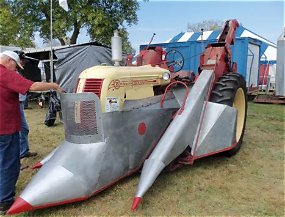
For many years my dad grew seed corn for Dekalb. There was a plant in nearby Warren, Illinois which made it very convenient. This is about the time of year when we would begin the harvest (late summer – early fall) depending on the maturity of the corn. The harvest crews were unique to this specific corn harvest. The corn was picked on the ear and trucked directly to the corn plant in town.
The crews were made up of four farmers each with mounted, two-row corn pickers on their tractors. In our neighborhood, we had two, four-man crews. When word came from the Dekalb Field Manager that it was time to harvest a particular farm, the farmers in their specific crew would ascend on the farm that was ready. It took a whole team to make it work. There were the farmers themselves. The trucking company. The corn plant. And the wives preparing the noon meal!
Early in the morning before the sun came up the straight trucks from Brown Trucking in Warren would assemble on the farm. The farmer had an elevator set up to load the trucks out of flare-box wagons. Eight loaded wagons from the night before would sit in the edge of the field waiting to be unloaded into the trucks. This was usually the job of me and my brothers. By the time the farmers finished up their chores in the morning, the wagons would be empty and ready to be loaded and unloaded all day long. The crews would work on one individual farm for anywhere from a couple days to a week or more, depending on the number of acres to be picked and the weather. The farmer’s wife would assemble her own crew to cook the noon meal for the farmers.
It was amazing the food they would prepare. To call it a feast would not do it, nor them, justice. No matter how much a farmer loved farming, he loved those noon meals more. They would come in from the field at exactly 12 o’clock, covered with dust from head to toe. A wash basin was set up in the yard near the front door. Each farmer would scrub their faces and arms in a sudsy wash and cough and blow their noses as they attempted to get the dust out of their nostrils and lungs. Then the feast would begin and quickly be consumed, complete with apple pie and ice cream for dessert. Us kids got to eat right alongside the men. After all, we were doing men’s work during those days. There would be time to play later.
The farmers were all characters in their own rite. The requirement of the four-man crew that was headed by Fay Tuescher was that their tractors had to be International Harvestores and their corn pickers had to be IH 234 pickers. No other tractor or picker was worthy to be on his team. His crew consisted of himself, Carson Balbach, Kenny Heimann and Bob Aurand. Fay’s picker was mounted on an 806 tractor, as was Kenny’s. Carson’s was mounted on a 560 and Bob’s 234 picker was mounted on an IH 856 – the newest and most impressive tractor of all. Bob had the awe and respect of us all.
Fay was a no-nonsense man. He was there to get the job done, period. Carson was a gentle, quiet man who always went out of his way to ask how you were doing and what new things were happening in your life. He took a genuine interest in you. For a 12 year-old that meant a lot. You had to shout when you talked to him because he couldn’t hear so everybody in the vicinity pretty-much knew what you were talking about. Kenny was all about socializing. He loved people. He loved the assembly of all the farmers and their families more than the farm work itself. He always had a story to tell about the history of the people on whose farm we were working. Bob was a friendly chap who was just happy to be involved in farming and interacting with other farmers. He always had a story to tell.
My dad’s crew consisted of Dad, Jimmy Rufenacht, Roger Eckerman, and Glen Miller. Dad was the new guy on the block after he purchased his farm in the neighborhood. He had two Yetter gravity boxes, but all the farmers said he had to get flare boxes that could be raised hydraulically or the corn wouldn’t run out. They were right. Us kids got tired of kicking the wet corn out of his gravity wagons and eventually dad bought two flare boxes at farm auctions. One for 180 bucks – with a Montgomery Ward running gear. The other wagon was purchased the same day by my brother at a different auction for 310 bucks. It had an “Electric” box on an Allis Chalmers running gear. They were both great wagons and did the job.
Dad’s corn picker was a New Idea mounted on a Cockshutt tractor. Jimmy had a Massey Ferguson picker mounted on a Massey Super 90 tractor. Roger had a New Idea picker also mounted on a Super 90. (Roger and Jimmy were cousins). Glen also had a New Idea picker, but I don’t remember his tractor. I think it was a Case.
Jimmy was a go-getter who loved speed. He usually went up and down the field a gear faster than everyone else. Roger was about as friendly as anyone you would ever meet. With four tractors going up and down the field, he waved at every driver every time they met, all day long. Each encounter was like the first to him. Glen was nicknamed “Breezy” because he never stopped talking. Even when he didn’t have anything to say, he found a way to say it. And he was oblivious to the other farmers teasing him for his ability to chat even though no one was listening. Either that, or he didn’t care.
Those memories all linger in my mind. Those men have all passed from this earth, but their personalities and impact live on in the life of this once impressionable young man (now much older).
Deuteronomy 32:7 reminds us to remember the days of old, to consider the generations that came before us, and to listen to the stories of our fathers and elders. We ought not to forget the sacrifices and work of those who came before us. Times change, communities change, and the landscape changes, but we still remember and appreciate the generations who helped shape the place we call home.
”Remember the days of old; consider the years of many generations; ask your father, and he will show you, your elders, and they will tell you,” (Deuteronomy 32:7).
(Kevin Cernek is Pastor of Martintown Community Church, Martintown, Wisconsin)