The Pastor’s Piece – Pastor Kevin Cernek, FCFI Chaplain
FCFI
September 20, 2026
A Greater Investment
My dad was a first-generation farmer. It wasn’t that grandpa didn’t want to farm. He simply grew up in a time when wanting to farm and being able to farm were two very different things. The Great Depression of the 1930s was hard on families, and for many young men, the dream of farming simply wasn’t financially possible.
Dad grew up during those difficult years. He would tell stories like when he and grandpa would walk along the railroad tracks with gunnysacks after the train went through, picking up chunks of coal that had fallen from the coal cars. Those chunks of coal would heat their house in the winter. Dad grew up in a world where you didn’t waste anything and where people learned early that hard work and resourcefulness were necessary just to get by.
Dad always wanted to be a farmer and eventually he found a way to get started. While in high school, he worked for a dairy farmer and found that he loved cattle. Also while still in high school, together he and Grandpa bought an 8N Ford tractor. It came with a complete line of equipment – a two-bottom plow, three-point disc, harrow, sickle mower, a two-row mounted planter, and a two-row cultivator. They didn’t have an actual farm to work. Instead, they traveled around the neighborhood farming every one or two-acre piece of ground they could find. It wasn’t much, but it was a beginning.
After getting married, serving in the military, and having a couple of sons, he and mom came home and dad went to work with my uncle at a steel mill. He worked at the mill when he was scheduled and farmed whenever he was off. Eventually, he bought a Ford Jubilee tractor and rented an 80-acre farm.
At one point, a farmer-friend of the family ran into some difficult times and was looking to sell out. He was asking $3,000 for his entire line of equipment. Included in that deal was a Farmall M and a Cockshutt tractor. Dad and mom took the leap, bought out the farmer, and went full-time into farming.
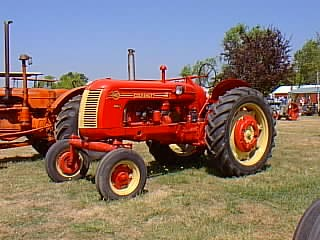
A Cockshutt was a rather unique tractor in its day. To us it was simply a big yellow-ish looking machine among all the other equipment dad had. But it has an interesting history.
Cockshutt was a Canadian farm equipment company. In 1960, White Motor Corporation purchased Oliver Corporation. Then, in 1962, White purchased Cockshutt. After the merger, some Cockshutt tractors were actually Oliver tractors painted red. In1963 White added Minneapolis-Moline to the family. Today, we still have dad’s Cockshutt tractor, the M, the 8N and the Jubilee – along with a bunch of other tractors dad owned over the years.
Along about 1967, Dad bought an International Harvester 303 combine. I remember it came with a ten-foot grain platform, but no corn head or cab over the operator’s station. A couple of years later, Dad bought a two-row corn head at a farm sale, and a private company came out and built a cab on the combine – no heat or a/c, but a couple steps forward nonetheless.
Our farm wasn’t a huge operation. Dad milked 42 cows. Milk was bringing around $3 a hundredweight. The cows probably averaged somewhere around 50 pounds of milk per cow per day, but dad made it work.
Years later, I drove by the place where Dad farmed during my early years. The house was gone, having burned in a fire many years ago. The old horse barn where we raised calves was gone too. I assume it eventually collapsed. The machine shed is still standing, but the doors are so small and low that ironically, the only equipment that fits inside are antique tractors.The dairy barn collapsed a few years ago.
A farm that once represented years of hard work has gradually been reclaimed by time. Buildings disappear. Equipment is hauled away. Fields change hands. The things that seemed permanent when you were a child turn out not to be permanent at all.
But the memories remain. From picking up pieces of coal to farming little plots of land to having his own dairy farm, Dad’s story was one of making something out of very little. None of it was extravagant. But it was progress. A farm doesn’t have to be large to be important. A tractor doesn’t have to be new to be valuable. A barn doesn’t have to stand forever for the work that happened inside it to matter. But the lessons learned there, the value of hard work, perseverance, making do with what you have, and building something one step at a time, can last forever.
Dad’s original farm doesn’t look the way it did when I was growing up. But in a very real sense, it is still there, in the memories, in the stories, and in the lessons that were passed down to the next generations.
There is also a spiritual lesson in all of this. Jesus reminded us not to make earthly possessions the treasure of our lives: “Do not lay up for yourselves treasures on earth, where moth and rust destroy… but lay up for yourselves treasures in heaven,” (Matthew 6:19–20).
What we build on earth will eventually pass away. But what we build in Christ – obedience to God’s Word and lives invested in His kingdom has eternal value that no fire, rust, collapsed barn, or passing generation can take away.
Dad spent his life serving the Lord and building a family – and he did a little farming along the way.
(Kevin Cernek is Pastor of Martintown Community Church, Martintown, Wisconsin)