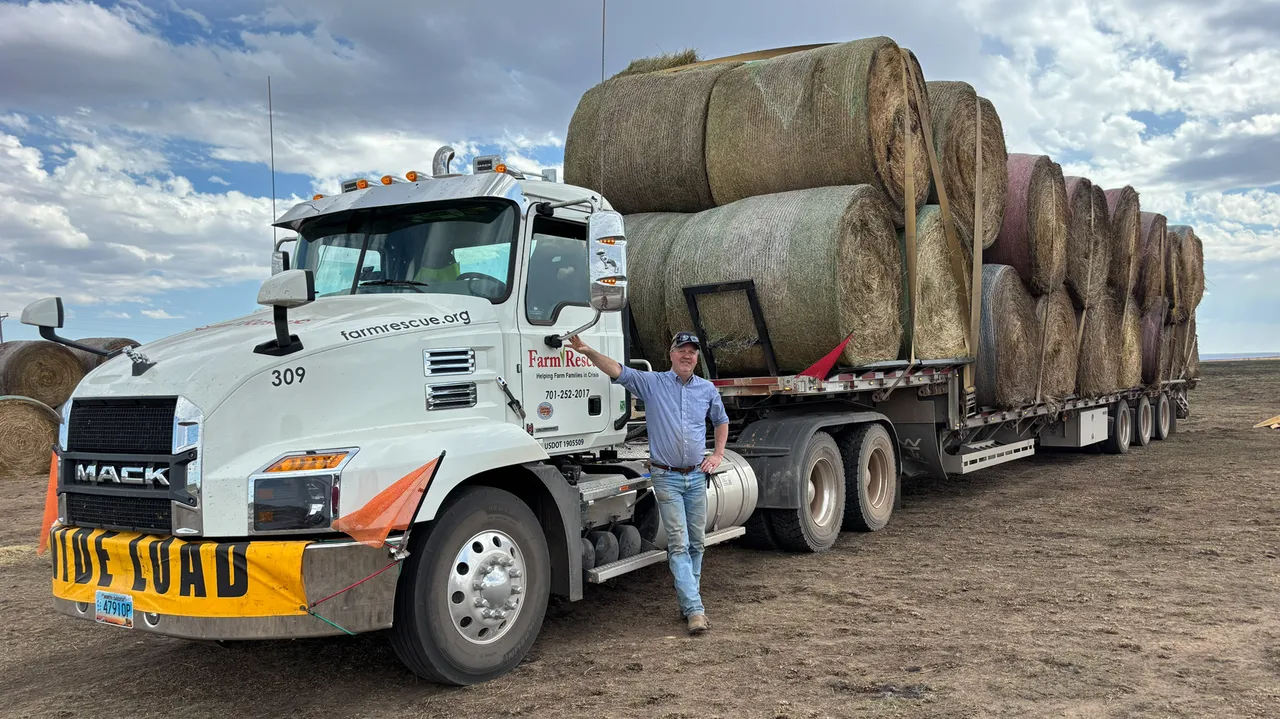
(Part 1) Farm Rescue Teams with FCFI to Bring Hay to Ranchers Impacted by Wildfires
OPERATION HAY LIFT: Mark Calderwood, Sterling, Kan., is one of several volunteer drivers taking donated hay to ranchers affected by wildfires through Farm Rescue’s “Operation Hay Lift.”
Mark Calderwood has a routine: carefully strapping down a semitrailer load of hay and checking his rig before hitting the road. But the reason behind this load—and his destination—is anything but routine.
Calderwood is one of several volunteers with Farm Rescue using their commercial driver’s licenses and time to haul donated hay to ranchers devastated by recent wildfires in Kansas and Oklahoma—and soon, Nebraska.
Operation Hay Lift
Farm Rescue’s “Operation Hay Lift” was launched to assist ranchers who lost pasture and feed supplies in the Ranger Road Fire, with support from the Fellowship of Christian Farmers, which helps offset transportation costs with fuel reimbursement and also covers food and lodging costs.
With historic wildfires burning more than 701,000 acres across Nebraska, Operation Hay Lift is expected to expand. The Ranger Road Fire alone scorched over 283,000 acres across Oklahoma and Kansas in late February, and 18 families in those states have signed up for assistance so far.
More than 1,000 hay bales have already been donated. Volunteer drivers include John Schnitzler (Wisconsin), Kenny Crites (Indiana), Mark Johnston (Illinois), David Endorf (Nebraska), Dean Issacs (Indiana), and Calderwood.
Volunteer Drivers Making a Difference
Calderwood, a retired teacher near Sterling, Kan., signed up last fall, detailing the skills he could offer. His CDL came in handy.
“They called me up and asked if I was a CDL driver. I said ‘yes,’ and they were really happy about that because it’s still hard to get a volunteer with a CDL,” Calderwood said.
Farm Rescue provides trucks and trailers, so volunteers only need to complete safety training and maintain certification.
“We go to collection points, load the hay, and the dispatcher directs us straight to the ranch to unload where it’s needed,” he explained.
Calderwood has picked up hay at Woodward Livestock Auction Inc. in Woodward, Okla., and a feedyard near Ashland, Kan.
More Than a Delivery
For Calderwood, volunteering is about more than hauling hay—it’s about connecting with resilient ranchers.
“Most of my interaction has been with farmers and ranchers, and these guys are great. They’re so appreciative and kind,” he said.
Many conversations revolve around his teaching career, retirement, and how he ended up helping deliver hay. But seeing families face repeated natural disasters is heart-wrenching.
“For a lot of them, it’s the second fire in 10 years. They went through the 2017 fire, and now this one,” Calderwood said.
Despite these hardships, ranchers show remarkable resilience. One Ashland-area rancher, even after losing pasture and cattle, offered guest housing to Farm Rescue drivers.
“The fires in the Heartland might be a brief news blip, but the recovery takes years. Cattle prices may be high, but if you lost all your cows, that doesn’t help. The resiliency here is amazing—they love what they do and will get back at it,” Calderwood said.
How You Can Help
Hay donations and monetary gifts to support transportation and logistics are welcomed. To contribute or request assistance, visit https://fcfi.charityproud.org/Donate or call Dan at (616) 676-6684 or farmrescue.org or call 701-252-2017 (Farm Rescue).
Cost-Share Assistance
The Kansas Department of Agriculture Division of Conservation has cost-share funds to assist landowners affected by February’s Ranger Road, Stevens, Tennis, Andrew Lane, and Rawlins County wildfires.
The Wildfire Recovery Initiative provides $151,000 in financial aid to landowners in eight counties: Barber, Clark, Comanche, Finney, Meade, Rawlins, Seward, and Stevens. Funds can cover cover crops, temporary watering facilities, and temporary electric fencing, with landowners eligible for up to $5,000.
Projects started but not completed prior to applying are eligible if receipts are kept and KDA specifications are followed. Applications are accepted until April 3 at agriculture.ks.gov/ConservationDistricts.
For questions, contact:
- Dave Jones – david.jones@ks.gov | 785-564-6623
- Madison Loder – madison.loder@ks.gov | 785-477-2788