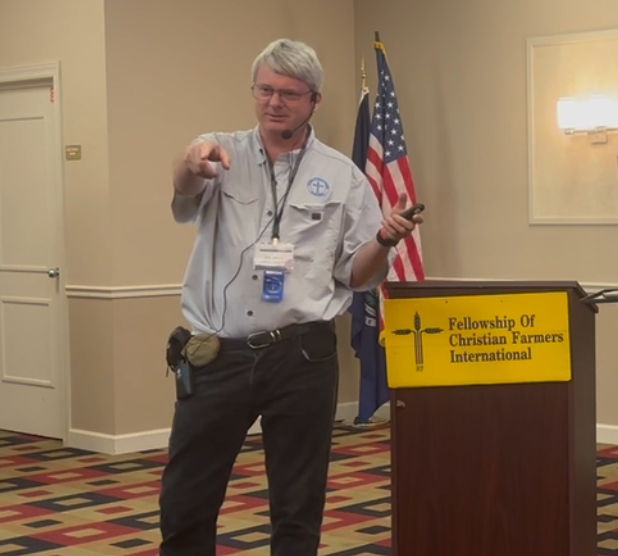
Passing the Mantle to the Next Generation of Farmers – by Dan Janzen
Young farmers today face pressures for which they are ill-prepared in terms of wherewithal and fortitude to appropriately respond to: exorbitant land prices which exacerbate generational succession, driven high by demand from corporations diversifying their investments to avoid inflation; volatile markets fluctuating in trade wars; high debt loads, in part driven by the perception or reality of efficiency of production correlated with very expensive machinery; isolation made worse by the breakdown of community support systems; and regulatory stress driven by media promoting alarmism through shocking stories that get more views and sell advertising.
These regulators are highly influenced by popular public opinion, which is shaped by these media outlets. They are completely out of touch with the intricacies of green revolution technology and often march to the beat of extreme environmentalists. When this deep ecology worldview gains popularity, the disdain and cultural hostility toward biblical stewardship principles increase.
Therefore, many are simply without the foundational tools of faith and the community fraternalism that, in bygone years, set in place by the Great Awakening Revivals, was intentionally engaged to support one another. Without intentional spiritual investment such as mentorship or discipleship, leadership development, and encouragement, they are at serious risk of being lost to the Church and to gospel-centered mission.
What concerns me most is not just staffing an organization—it’s losing a generation of frontline gospel witnesses and disciplers in rural America. Farmers have always been uniquely positioned to share the gospel with other farmers and poised to initiate revival. If that link is broken, it will take decades of high-level dedication to spiritual formation on a par of scale with the early church or Great Awakening Revivals on to rebuild.
We need to be concerned enough about the future of FCFI if younger rural believers do not step into leadership, being propelled to act with excellence. But I am also hopeful—because when young farmers are discipled, invited, entrusted or given real responsibility, they rise to the occasion with strength, vision, and endurance.
Here are specific ways churches can move from talk to action, particularly as it concerns discipleship:
1. Treat Farming as a Mission Field, Not Just an Occupation
Young farmers need to hear clearly:
“Your farm is a mission field. Your barn is a sanctuary.”
Then they need to be infused with ideas of how to be more missional so they are given an opportunity to find fulfillment in the Great Commission (discipling all nations). Affirming farming as a missional calling—not just a job—changes everything.
This is why FCFI has been engaged in developing Farm Genius, a planning program that introduces the farmer to a plethora of ways to find fulfillment through exploring all the ways farm property and farm businesses can be used missionally.
2. Financial & Practical Start-Up Support
Churches routinely help plant churches but rarely help plant farmers. Ideas include:
- Low-interest equipment or land access funds through “angel” initiatives
- Inventory equipment online and co-op style, sharing equipment and tools with young farmers who are vetted as responsible
- Expansion of custom and contractual agreements mediated by the church to increase the efficiency of farming
- Scholarships for ag training tied to Christian discipleship or ministry engagement
- Developing and explaining online lists of resources
- Networking and integration of value-addition and marketing opportunities between urban and rural churches connected to local farmers
3. Mentorship Across Generations
Older farmers need to coach one another about how to engage with younger farmers and be bold enough to ask questions about their pain points.
Pair retiring farmers and leaders with young farmers for:
- Business financial wisdom or consulting
- Faith and spiritual formation mentorship
- Life and marriage support
This also gives older rural believers continued purpose.
4. Leadership Opportunities Given Before “Perfection”
Young people rarely lead because we don’t let them lead. After appropriate vetting (see biblical qualifications of a deacon), let them LEAD!:
- Teach, serve, organize outreach
- Lead disaster response crews or take increasing responsibility in those crews
- Represent the church (i.e., our FCFI gospel booth) at ag events
Faith grows most quickly under responsibility.
5. Spiritual Resilience Training
Young farmers need more than motivational talks; they need:
- Biblical worldview training
- Apologetics
- Discipleship systems that work in rural communities, not just classrooms
This is one reason FCFI is investing in digital discipleship and automation as a follow-up system for our farm and FFA evangelism. Harold.chat, an online app released by FCFI, functions as a biblical or pastoral scholar that will answer any question from a biblical worldview. It has also been programmed with 70 George Barna-style worldview questions. When at least 10 are answered, it custom-makes a discipleship plan tailored to shore up weaknesses in worldview and replace them with a truth-based biblical worldview.
Continuously flashing across the top of the screen is the question: “Would you like to connect with a discipleship coach?” These contacts are passed to online disciplers who are “waiting in the wings” for such divine appointments. They also vet local churches for opportunities to pass on the discipleship responsibilities.
Farm Genius is built to expose ideological errors and not only highlight the economic opportunity cost of choosing goals that do not align with a biblical worldview, but also introduce a plethora of strategic ministry alternatives.
In Conclusion:
If the next generation of farmers is not intentionally discipled and equipped for leadership, we will lose far more than an organization—we will lose a critical voice for spiritual transformation in rural America. Young farmers today are under immense pressure economically, emotionally, and spiritually. Churches must move beyond encouragement to active investment. When young believers are trusted with responsibility, grounded in Scripture, and supported by their churches, they do not shrink from leadership—they rise to it.
This is not about preserving an institution. It’s about passing the torch of gospel ministry, integrated with a discipleship ministry to the next generation. Please contact Dan Janzen at dan@fcfi.org if you would like to help with discipleship of our FFA youth and others we meet at our outreach events (farm shows, fairs, festivals, FFA conventions, etc).